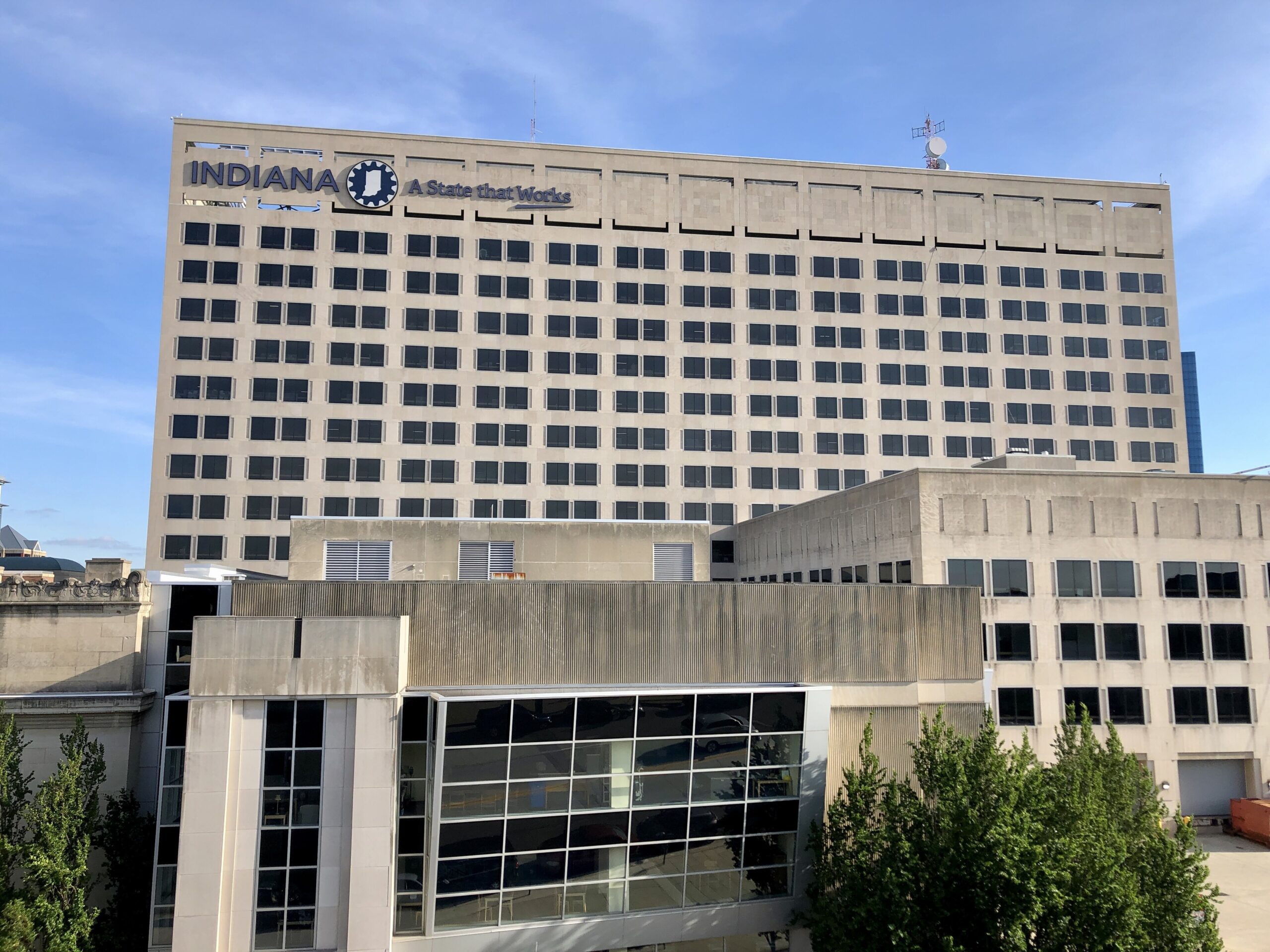
Indiana Has 104,186 Fewer People on SNAP Than a Year Ago, and the State Says Missing Verification Paperwork Is a Prominent Reason
Tyson Runkle, a spokesman for Indiana’s Family and Social Services Administration, said “failing to provide requested verification information” is one prominent reason Hoosiers have been removed from the Supplemental Nutrition Assistance Program for noncompliance, according to a report by Mackenzi Klemann published by WNDU. In plain terms, a household that does not return the paperwork the state asks for by the due date can be removed from the program.
The scale is now visible in federal data. Indiana had 577,352 people on SNAP in July 2025 and 473,166 in July 2026, a drop of 104,186 people, or about 18%.
How Big Is the Drop, Measured July to July?
The comparison is July 2025 against July 2026, both taken from one USDA Food and Nutrition Service table titled “Supplemental Nutrition Assistance Program: Number of Persons Participating,” which was current as of Oct. 9, 2026. It lists Indiana at 577,352 participants in July 2025, a preliminary 488,244 in June 2026 and an initial 473,166 in July 2026. The table shows July 2026 down 18.0% from July 2025 and down 3.1% from June 2026.
Subtracting 473,166 from 577,352 gives 104,186. Dividing by 577,352 gives 18.04%. The table notes that June and July 2026 figures are preliminary and subject to significant revision, and that the data may include disaster assistance, so the exact total could move.
Indiana’s drop is larger than the nation’s. The same table puts U.S. participation at 41,603,048 in July 2025 and 36,087,667 in July 2026. A calculation from those totals: the national decline is 5,515,381 people, or about 13.3%, compared with Indiana’s 18.0%. The USDA’s SNAP data tables page lists July 2026 as the latest available month and was last updated Oct. 20, 2026.
Earlier figures show the slide was gradual. FSSA data cited by WFYI, republished by Mirror Indy, had statewide enrollment at 588,184 in April 2025 and 508,166 in April 2026, a decline of nearly 14%. The same report put Marion County at about 131,000 people in March 2025 and about 108,000 in March 2026, a 17.5% decrease.
What Does a Missed Verification Request Cost a Household?
FSSA’s own page on the program says applicants must provide names, birth dates and Social Security numbers for everyone in the home, plus proof of income and resources, child support paid, shelter costs and dependent or adult care costs. Medical expense proof is needed for a deduction for a disabled or 60-plus household member. The state’s SNAP page says a worker conducts an interview and gives the household a form listing the required information and a due date. The Division of Family Resources must receive the information on or before that date.
FSSA’s older SNAP FAQ, dated 2020, says the same about due dates and adds that benefits stop until pended verification is provided.
The rules for existing cases are in FSSA’s policy manual. Its chapter 2200 gives 13 days to verify a redetermination, and says that if verifications are not received by the 13th day, the redetermination is denied. The chapter also says a denial is rescinded if all required verifications arrive before the end of the month after the certification period ends. Negative actions require 13 days of advance notice, and a discontinuance takes effect on the first day of the following month.
For a redetermination denied over missing paperwork, that rescission window is the household’s chance to fix the problem. Households with a pending request can contact the Division of Family Resources at 800-403-0864, the number FSSA lists for applications and appeals.
Can FSSA Say How Many Removals Were Paperwork?
Not yet, according to the same WNDU report. FSSA could not say how many removals were due to ineligibility and how many were procedural. That limits what the 104,186 figure proves: it counts people who left the rolls over the year, not the reason each one left.
The report did offer a monthly pattern. Nearly 13,000 Hoosiers lost benefits between October and November 2025, more than ten times the previous month’s number. Removals were about 12,500 the next month and 14,000 in January, and they peaked at 16,000 in May. The report put the total at about 82,000 fewer Hoosiers on SNAP since the federal law took effect last October, a 14.5% drop from October 2025.
That 82,000 is a different measuring stick from the USDA’s July-to-July 104,186. It starts in October 2025, while the USDA comparison starts in July 2025, three months earlier.
Emily Weikert Bryant, executive director of Feeding Indiana’s Hungry, told the outlet that benefits end if work, school or volunteer hours are unmet for more than three months in a three-year period. Runkle’s explanation addresses removals for noncompliance, a narrower category than every closure.
Which Rule Changes Landed in the Same Year?
Federal and state changes took effect together. According to the Mirror Indy report, the federal One Big Beautiful Bill Act, signed in 2025, cut SNAP funding by $186 billion and expanded work requirements to many adults ages 55 to 64. Indiana’s Senate Enrolled Act 1 ended the state’s use of expanded categorical eligibility, which the state estimates will remove about 3,112 households, and tied asset limits to federal rules.
FSSA’s page lists the current asset limits as $3,000 for a household with no elderly or disabled member and $4,750 for a household with a member 60 or older or disabled. Under the federal law, the page says, the age exception for work requirements now covers people 65 and older, the child exception applies only to children under 14, and exceptions for homeless individuals, veterans and people who aged out of foster care were removed.
Applicants must also report the citizenship or immigration status of everyone in the household, even non-applicants, and the Division of Family Resources must report any member whose status cannot be verified to the USDA, according to Mirror Indy. Dr. Shellye Suttles of the Indianapolis Office of Public Health and Safety said: “Neither local government nor charitable food assistance is going to be able to offset the reduction in benefits.”
Other states have posted large declines too. The Tonic Edit has reported on Ohio’s 128,843-person drop, Oklahoma’s loss of 154,803 recipients and Nevada’s decline of 112,994 people.
What Should Households Still Enrolled Watch For?
The first is the paperwork due date, because Runkle named missed verification as a prominent reason for noncompliance removals. FSSA says applications can be filed online through the FSSA Benefits Portal or in person at a local Division of Family Resources office.
The second is a new expiration rule. FSSA’s page says that starting Nov. 23, 2026, unused benefits at least 274 days old are removed from EBT accounts and cannot be replaced. Households that save benefits on the card for months should check balances before that date.
The third is cost sharing, which ties some of the state’s spending to its accuracy. Starting in October 2026, Indiana pays 75% of administrative costs, according to the WNDU report. If the state’s payment error rate stays above 6% when the next phase starts in October 2027, it must pay part of benefit costs, a minimum of about $64 million, according to Sunshine Beam, director of FSSA’s Division of Family Resources. Indiana’s error rate was 9.77% in 2025, and Beam said the rate is trending down: “These changes, both at the federal and at the state level, do not appear to have made the error rate worse.”
Lawmakers are expected to take up SNAP funding when they write the two-year state budget starting in January, according to the report.
Get stories like this by email. Sign up for The Parent Diaries Letter.
This article was produced with AI assistance and edited for accuracy against the sources linked above.
Image: IndyTaylor – CC BY-SA 4.0/Wikimedia Commons