Washington’s Minimum Wage Climbs to $17.73 an Hour on Jan. 1, and Seattle Workers Go to $22.14
Seattle’s minimum wage and Washington’s statewide minimum are both going up on Jan. 1, and the gap between them is staying wide: $22.14 an hour inside the city, $17.73 everywhere the state rate is the floor. That is $4.41 an hour apart, on a full-time schedule more than $9,000 a year.
The statewide figure comes from the Washington Department of Labor & Industries, which announced it Sept. 30, about three months before it takes effect. The state’s minimum wage page lists $17.73 for 2027, up from $17.13 in 2026. Seattle’s Office of Labor Standards lists the city’s rate going from $21.30 to $22.14 on the same date.
How the state sets its number
The department adjusts the minimum wage every year for inflation, using the federal Consumer Price Index for Urban Wage Earners and Clerical Workers, known as CPI-W. The calculation begins in mid-September, the agency says, the new rate is announced Sept. 30 and it takes effect Jan. 1. The $0.60 increase is 3.5%, according to an analysis of the 2027 changes published Nov. 4 by the law-firm commentary service JD Supra.
For most workers in the state, $17.73 is the rate. The department says most agricultural and non-agricultural jobs qualify for the minimum wage, while some workers can be paid less, including certain criteria-based workers and jobs exempt from the Minimum Wage Act. Workers ages 14 and 15 can be paid no less than 85% of the minimum wage, which the department lists as $15.07 an hour for 2027.
Seattle’s own scale
Seattle sets a separate minimum for employees working inside city limits. According to the Seattle Office of Labor Standards, the city’s wage rises every Jan. 1 based on the CPI-W for the Seattle-Tacoma-Bellevue area, and the office announces the next year’s increase by the fall. For 2027 the rate is $22.14, up $0.84 from $21.30.
The city’s page says that since Jan. 1, 2025, all employers pay the same minimum wage regardless of size. Small employers can no longer count tips or payments toward an employee’s medical benefit plan toward the minimum compensation requirement.
What the raise adds up to over a year
The arithmetic for a full-time schedule is simple. At 40 hours a week for 52 weeks, or 2,080 hours, the statewide rate of $17.73 comes to $36,878.40 before taxes, compared with $35,630.40 at the 2026 rate of $17.13. That is $1,248 more across the year. In Seattle, $22.14 comes to $46,051.20, against $44,304 at $21.30, a difference of $1,747.20. These figures are illustrations of the published rates, not what any particular worker will take home.
Overtime follows the base rate. JD Supra lists the overtime rate at minimum wage as $26.60 an hour statewide and $33.21 in Seattle for 2027. Washington’s premium pay after 40 hours a week is generally one and one-half times the regular rate, according to the U.S. Department of Labor’s state minimum wage table.
Salary lines for exempt workers move too
The statewide minimum wage also sets the salary threshold for executive, administrative and professional employees who are exempt from overtime. JD Supra lists the 2027 thresholds as $1,595.70 a week, or $82,976.40 a year, for employers with one to 50 employees, which is 2.25 times the state minimum wage. For employers with 51 or more employees the threshold is $1,773 a week, or $92,196 a year, which is 2.5 times the minimum wage.
Those numbers matter to salaried workers as well as hourly ones. An employee paid below the threshold for the employer’s size generally cannot be treated as exempt from overtime under the state’s rules.
Other Washington cities with their own floors
Seattle is not the only city above the state rate. The department says Seattle, Bellingham, SeaTac, Tukwila and Renton have higher local minimums, and JD Supra adds Everett, Burien and unincorporated King County. The 2027 amounts for those places are not listed in the sources, so a worker in any of them would check the local government’s page.
The department’s local minimum wage page still shows the 2026 figures. Seattle was $21.30, Tukwila $21.65, SeaTac $20.74 for hospitality and transportation employers and Bellingham $19.13. Some of those rates vary by employer size, and Renton, Everett, Burien and King County have tiered schedules that include mid-year steps.
Compared with other places, the Labor Department’s table lists current basic rates of $16.94 in Connecticut, $16.90 in California, $16.00 in Hawaii and Rhode Island and $15.92 in New Jersey, with the District of Columbia at $18.40. Washington’s $17.13 is above each of those states’ figures on the page as it stands today. Other states also adjust on Jan. 1, so those rankings can change once the new year’s rates are posted.
The federal minimum is far lower. The Labor Department’s table lists $7.25 an hour federally and $17.13 for Washington under current rates, so Washington’s state law is what governs pay for covered workers.
Get stories like this by email. Sign up for The Parent Diaries Letter.
This article was produced with AI assistance and edited for accuracy against the sources linked above.
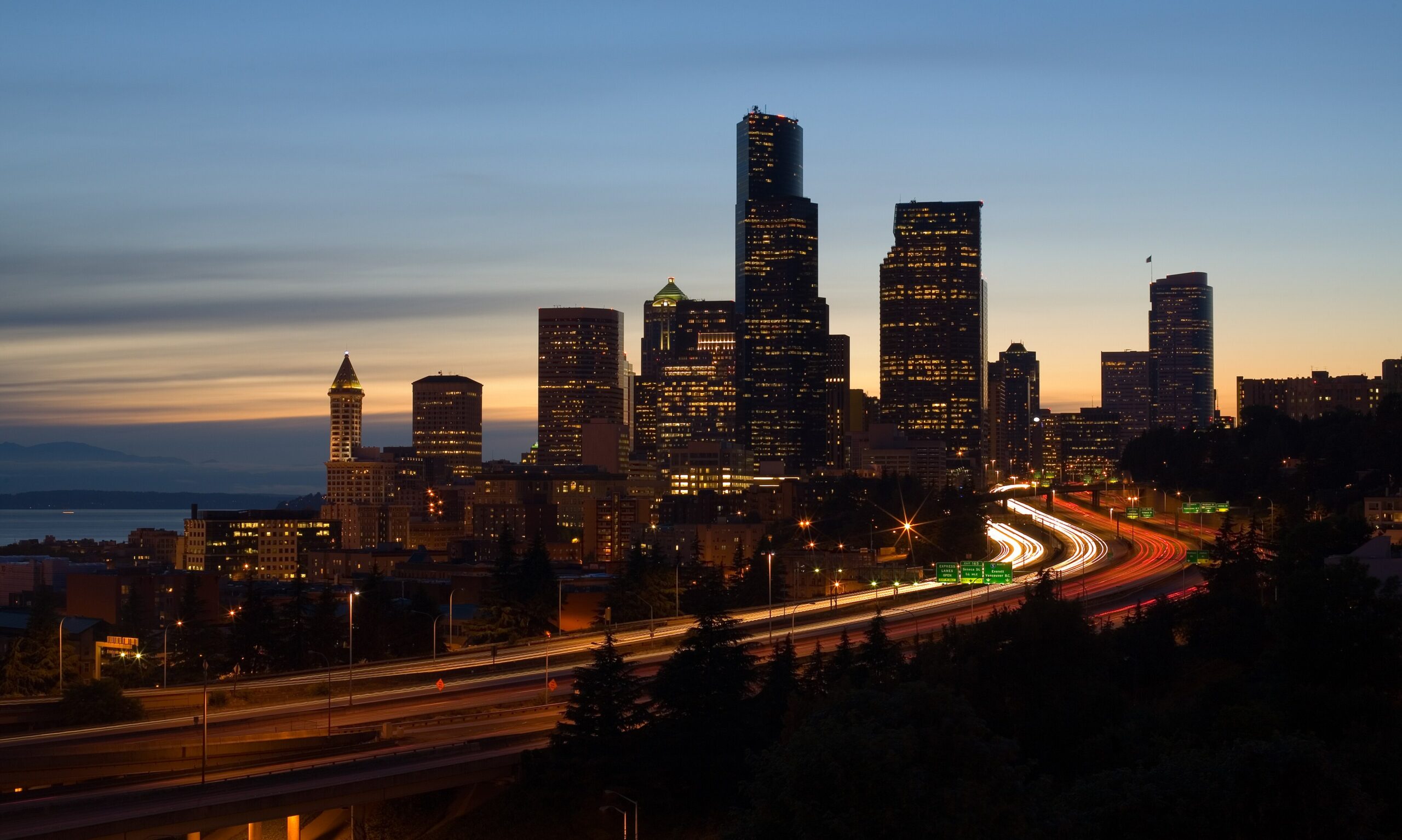
Image: Cacophony – CC BY-SA 3.0/Wikimedia Commons