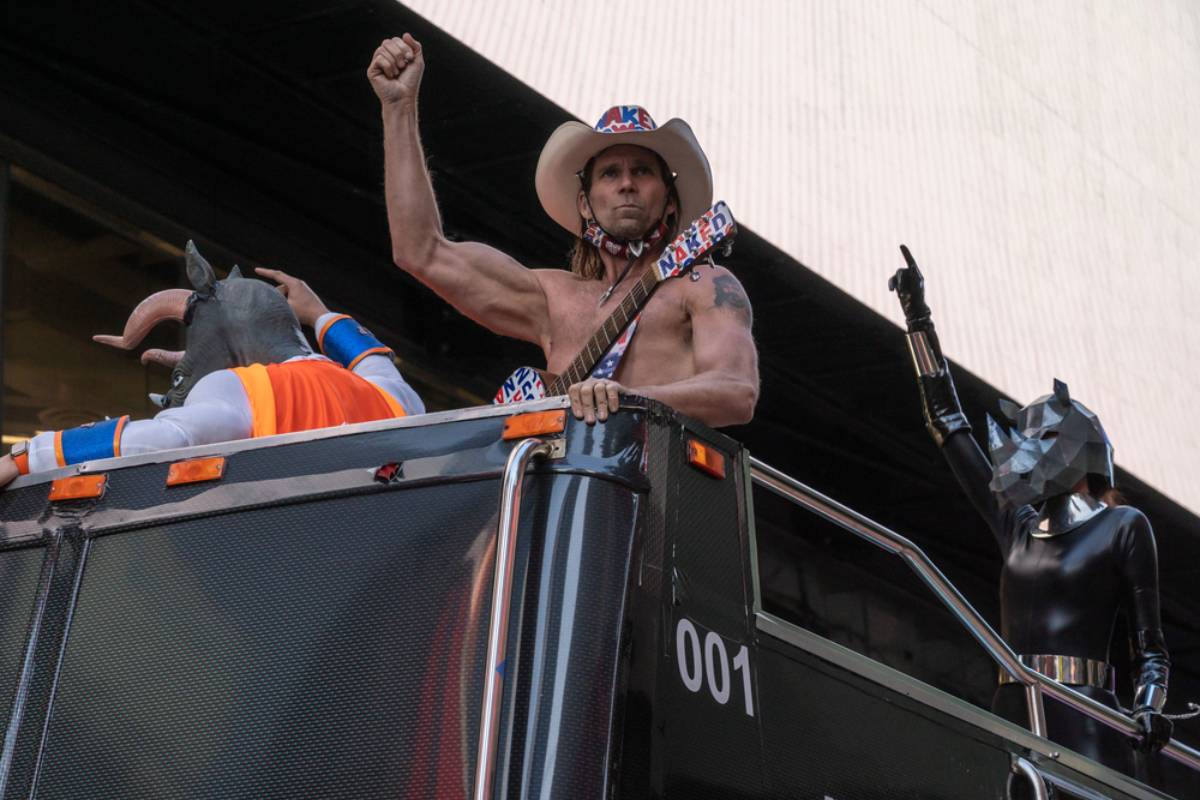
The Naked Cowboy Says His Times Square Act Can Earn $150,000 a Year, but the Surprising Costs Behind His Famous Career Tell a Different Story
Robert John Burck II, better known as the Naked Cowboy, says his unusual career entertaining tourists in New York City’s Times Square brings in an average of approximately $150,000 a year. In an October 2026 Business Insider profile, the 55-year-old performer explains how he earns money through street performances and several businesses connected to his instantly recognizable character. His financial picture also includes rent, transportation, food, work equipment, medical expenses, and savings.
The average, however, does not tell the whole story of his finances. Burck says his best year brought in as much as $250,000, while several consecutive years delivered only $25,000 to $30,000 annually. The difference shows how unpredictable earnings can be when a career depends on a distinctive public persona and several sources of revenue rather than a conventional salary.
A Photo Shoot Helped Create the Character
The origins of the Naked Cowboy date back to the late 1990s, when Burck was pursuing opportunities as a model and performer. A 2015 report from Money recounts how a photo shoot for Playgirl in California led him to try performing in his underwear rather than wearing his complete cowboy outfit. The change helped him attract attention and earn money from people watching him perform.
The exact chronology varies slightly between early accounts, but the basic story is consistent. A January 1999 Los Angeles Times profile described Burck’s experience performing on the Venice Beach boardwalk, where his more revealing outfit drew a better response than his fully clothed appearance. That early success helped establish the combination of music, cowboy attire, and a deliberately unconventional appearance that became his signature.
The Road to New York Was Not Straight
Before becoming a familiar figure in Times Square, Burck tried taking his performance to different cities. In a 2015 interview with City & State New York, he recalled traveling extensively and encountering police and local authorities as he attempted to establish himself. His account described being turned away from numerous places before eventually concentrating on New York.
That journey helped him discover the importance of finding a location where people could encounter his character repeatedly. Times Square offered a steady stream of tourists and pedestrians, giving him opportunities to perform, pose for photographs, and receive tips. Rather than constantly introducing the act to entirely new audiences, he could return to a recognizable setting and build familiarity over time.
The Costume Became a Business Asset
Burck’s outfit is more than an unusual costume; it is the visual identity around which his business operates. The cowboy hat, boots, underwear, and guitar make the character recognizable without a complicated introduction, while the performance itself gives tourists a reason to stop and interact with him. That combination has allowed the act to become identifiable beyond the particular moment when someone encounters him on a New York street.
His branding has also had legal significance. In 2008, Burck brought a case against Mars and an advertising agency over a blue M&M character dressed in a similar cowboy outfit and carrying a guitar, as recorded in the federal court opinion in Burck v. Mars. The court allowed his trademark infringement claim to proceed while dismissing his privacy claim at that stage of the litigation. The ruling was not a final determination that the alleged infringement had been proved, but it illustrates the commercial importance attached to the identity he had developed.
Tips Are Only One Part of His Income
Tourists handing over money in Times Square are the most visible part of Burck’s business, but they are not his only customers. In a companion Business Insider feature based on his interview, he described a previous year’s income as coming from street tips, personalized videos, Naked Cowboy Enterprises, and Naked Cowboy Oysters. His figures included approximately $20,000 from tips, $50,000 from Cameo, $7,800 from Naked Cowboy Enterprises, and $10,000 connected to the oyster business.
Those individual amounts add up to approximately $87,800, close to his broader description of roughly $80,000 for that year. The figures are rounded estimates he supplied rather than an independently audited financial statement. Even so, the breakdown offers a more revealing picture than the headline average because it shows how income from several activities contributes to the business.
Cameo Expanded His Audience Beyond Midtown
One of Burck’s most significant additional revenue streams comes from Cameo, a service where customers pay public figures to record personalized video messages. He says he earned around $50,000 through the platform in the year discussed in the interview. Requests can involve greetings for occasions such as birthdays and anniversaries, allowing the Naked Cowboy character to reach customers who may never visit Times Square.
Burck described the service as a major turning point because it almost doubled his income. That is a meaningful distinction for a performer whose traditional work depends on people physically encountering him in a busy public space. Personalized recordings give customers another way to pay for the character, although the amount earned can still change with demand.
The Oyster Business Added Another Revenue Stream
The Naked Cowboy name has also appeared on an oyster business, extending the character into a market far removed from street entertainment. Burck attributed approximately $10,000 in income from Naked Cowboy Oysters to the year discussed in his interview. The arrangement demonstrates how a recognizable performer can participate in a product business without relying exclusively on people watching him sing.
The available reporting does not provide a full breakdown of the oyster venture’s ownership arrangements, operating costs, or profit margins. Consequently, the reported income should not be confused with the company’s total sales or the amount of money Burck necessarily keeps after expenses. What it establishes is that the persona has generated revenue through more than one type of customer transaction.
His Business Extends Beyond the Street Corner
Another source of income is Naked Cowboy Enterprises, which Burck said contributed approximately $7,800 during the year he discussed. An earlier Brick Underground profile documented other uses of the character, including franchise performers and paid wedding officiation. That reporting shows that the business had begun extending beyond Burck’s own daily performances well before his latest financial interview.
These additional activities give the brand ways to generate money outside its owner’s usual working hours in Times Square. They also make the overall business more complicated than a straightforward exchange of music and photographs for tips. Without a complete breakdown of contracts, royalties, and operating costs, however, it is impossible to determine the exact profitability of each individual venture.
A Strict Routine Supports the Career
Burck says consistency has been central to maintaining the Naked Cowboy character for nearly 28 years. His usual routine begins with hours of reading, followed by a gym session, before he drives to his Times Square garage and starts performing. He generally works in the plaza from around 11 a.m. until approximately 5 p.m.
The routine is not limited to the days he spends in New York. Burck says he takes his hat, boots, and underwear with him when traveling, treating other trips as opportunities to continue working when possible. The arrangement allows him to maintain a recognizable identity across different settings rather than treating the character as something that exists only on one street corner.
Food Is One of His Biggest Daily Expenses
One of the more surprising figures in Burck’s financial account is his reported food spending of approximately $120 a day. He says his regular meals include as many as 12 egg whites before leaving home, followed by sushi and a protein shake purchased from a Times Square deli. If maintained throughout a full year, that daily estimate would amount to roughly $43,800.
Burck describes food as his largest expense and says he keeps his eating habits highly consistent. The figure is his own estimate, not a separately verified household budget, but it highlights how a demanding personal routine can carry substantial recurring costs. For someone who spends hours training and performing, food is an everyday expense rather than an occasional discretionary purchase.
Keeping the Act Ready Costs Money
Burck estimates that his work-related expenses total approximately $11,000 annually. He includes items such as cowboy hats, boots, guitar strings, gas, and his gym membership among the costs associated with maintaining the character. Although the act may appear simple from the outside, keeping the performer equipped and ready to work requires repeated spending.
These costs are separate from the larger amounts he has described for housing, food, and transportation, although the reporting does not fully explain whether every expense category is classified consistently. A guitar and a recognizable costume may last for some time, but they still require upkeep and occasional replacement. The business therefore has an operating budget even though it does not resemble a traditional shop or office.
His Car and Queens Apartment Add to the Bill
Burck says he moved into an apartment in Queens with his wife about 14 years ago after previously living in a New Jersey hotel. His current monthly rent is approximately $2,100, a figure he says includes the garage he uses in connection with his work. The garage is especially relevant to his setup because his car serves as a place to keep equipment and take breaks from the weather.
Transportation is another major expense in his account. Burck estimates that driving, travel, parking, and congestion-pricing charges amount to around $3,000 each month. The reporting does not spell out precisely how those costs overlap with the gas and other items in his separate annual work-expense estimate, but the monthly figure illustrates how expensive it can be to maintain a car-centered working routine in New York City.
Health Insurance Is a Significant Financial Gap
Burck says he has never had health insurance and paid approximately $3,600 out of pocket for medical checkups and urgent-care visits during the year covered by his account. He described those visits as involving relatively minor medical needs rather than a major hospitalization. Nevertheless, the reported expense demonstrates that healthcare is a separate financial consideration for him.
His situation is notable because his reported income can vary substantially from year to year. Without insurance, medical bills may have to be covered directly rather than through a health plan, making the size and timing of expenses important. The interview does not provide enough information to calculate his potential future medical costs or establish what insurance options might be available to him.
Savings and a Financial Manager Provide Some Security
Despite the irregular nature of his earnings, Burck says he has taken steps to preserve part of the money he makes. He reported holding approximately $250,000 across a cash management account and an individual retirement account, with a financial manager helping oversee his finances. He also said he has no debt.
Burck described a long-standing relationship with the same credit card and banking arrangement in Green Hills, Ohio, despite living and working in the New York area. Those details suggest that his approach to money includes keeping a financial base separate from the daily act of earning cash in Times Square. The balances and debt figures are self-reported, however, and the available account does not provide a full statement of his assets, liabilities, taxes, or retirement projections.
The Trade-Off Behind a Career Built Around One Character
The Naked Cowboy’s financial story is not simply about how much a person can earn by performing in underwear and playing guitar for tourists. It is about turning a memorable public identity into several revenue streams, then paying the costs of keeping that identity active year after year. Street tips remain part of the business, but video messages, business ventures, and product-related income help broaden the opportunities.
The trade-off is that the business still depends on a character Burck must continually maintain, supported by a routine that includes travel, equipment, food, housing, and other expenses. His reported savings and lack of debt offer a different picture from the years when earnings fell to $25,000 or $30,000. For Burck, the financial goal appears tied not just to maximizing income, but to preserving a career he has chosen to continue.