What Happens to Social Security Checks If Congress Doesn’t Act: The 2026 Trustees Report Says the Retirement Fund Could Pay Only 78% After Late 2032
The 2026 Social Security Trustees Report projects that the trust fund behind retirement and survivor checks will run out of reserves in the fourth quarter of 2032, and that incoming revenue would then cover 78% of scheduled benefits. For a retiree who counts on a deposit on the same day every month, that figure is the one to understand. It does not describe a program that stops paying, and it does not describe a cut that has already been decided.
The numbers come from the Social Security Administration’s Office of the Chief Actuary and the four-member Board of Trustees that signs the report. What follows is what the report says, what it leaves open, and what lawmakers have on the table.
Late 2032 and 78%: what the Trustees actually projected
According to the Trustees Report summary posted by the SSA’s Office of the Chief Actuary, the Old-Age and Survivors Insurance (OASI) fund is projected to be depleted in the fourth quarter of 2032, one quarter earlier than last year’s report. At that point, 78% of scheduled benefits would be payable, and the summary projects that share to decline to 62% by 2100.
The SSA’s June 9 announcement of the report says the same thing in plain terms: OASI reserves are projected to be depleted in the fourth quarter of 2032, leaving 78 percent of benefits payable. Axios, reporting on the release, described the shortfall as a cut of roughly 22% that would reach more than 70 million beneficiaries if nothing changes.
The report treats the retirement fund and the disability fund separately, as the law does. The Disability Insurance (DI) fund is not projected to be depleted at any point through 2100, so disability checks are fully payable throughout the 75-year window.
Why the fund runs low but the checks keep coming
Depletion is not the same as insolvency in the everyday sense. The Trustees’ summary says that starting at the depletion dates, “less than full scheduled benefits would be payable.” The 12.4% Social Security payroll tax, split between employee and employer, keeps flowing in either way.
Alicia Munnell of Boston College’s Center for Retirement Research wrote that “it is crucial to emphasize that the depletion of the trust fund in 2032 does not mean that OASI has run out of money.” Her analysis of the 2026 report puts the payable share at about 78%, falling to 62% by 2100.
The reason the share falls short is arithmetic. The Trustees’ summary shows the system’s non-interest income at 12.91% of taxable payroll in 2026, against a projected cost rate of 15.37%. The summary says OASDI cost exceeded income by $160.2 billion in 2025, and that OASI reserves stood at $2,338.3 billion at the end of that year.
What a 22% shortfall would look like on a monthly check
The report does not give a dollar figure for an individual check, and the sources reviewed do not either. The percentage, though, translates directly. If a beneficiary is scheduled to receive $2,000 a month, 78% of that is $1,560, or $440 less. The same math applies to any amount: multiply the scheduled benefit by 0.78.
About 62.3 million people were receiving OASI benefits at the end of 2025, and another 8.2 million were receiving DI benefits, according to the Trustees’ summary. Combined, Social Security paid about $1.60 trillion in benefits in 2025, the SSA said in its announcement.
Munnell’s analysis adds a measure for future retirees: the typical age-65 retiree’s replacement rate, the share of pre-retirement earnings that Social Security replaces, would drop from about 36% to about 29% if benefits were cut to the payable level.
The combined-fund date of 2034 and why it is not the planning date
A second number circulates in coverage of the report: the combined retirement and disability funds last until the third quarter of 2034, when 83% of benefits would be payable. The Trustees’ summary reports both figures, and the SSA’s announcement says combined reserves run out in 2034 without congressional action.
Axios pointed out that the 2034 date would require Congress to merge the two funds, which current law does not allow. Under existing rules, the retirement fund’s late-2032 date is the one that governs retirement and survivor checks.
The long-range gap also widened. The SSA said the 75-year actuarial deficit is 4.42% of taxable payroll, up from 3.82% in last year’s report. Munnell’s analysis cites the lower fertility assumption of 1.75 children per woman, reduced immigration, and tax changes in the 2025 tax law as the main drivers.
What Congress could do, and who says it should move first
The Trustees do not recommend a specific fix, but the summary gives the size of the problem. A uniform payroll tax increase or a uniform benefit reduction starting in 2026 could bring OASI into balance over 75 years, the summary says, and the Trustees urge lawmakers to act sooner because that allows more options and more time to phase in changes.
Munnell’s analysis quantifies the stark versions: an immediate payroll tax increase of 4.42 percentage points, split between workers and employers, or an immediate 22% benefit cut rising to 38% by 2100. She argues a mix is the more politically feasible path and that acting early “would keep more options open.”
The options reported by 6abc include raising the payroll tax rate, raising early or full retirement ages, applying the payroll tax to a larger share of income, and reducing benefits or slowing their growth. AARP chief executive Myechia Minter-Jordan said the report “should be a wake-up call: Congress needs to act,” according to that report.
The 2026 Trustees are Treasury Secretary Scott Bessent, Social Security Commissioner Frank Bisignano, Health and Human Services Secretary Robert F. Kennedy Jr. and Acting Labor Secretary Keith Sonderling, the SSA’s announcement says. NBC Palm Springs reported that House Speaker Mike Johnson said he has a plan to address entitlement spending but gave no details. Axios noted that the forecast could change, and a fix passed before late 2032 would leave the 78% figure as a scenario that never happens.
This article was produced with AI assistance and edited for accuracy against the sources linked above.
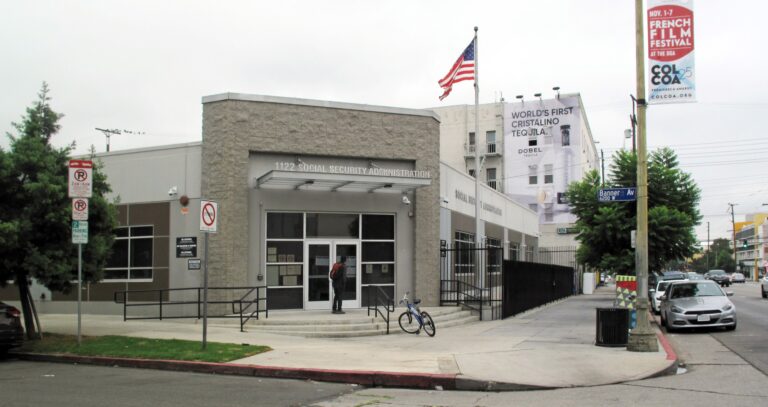
Image: “Social Security Administration Building – panoramio” by Corey Coyle is licensed under CC BY 3.0. To view a copy of this license, visit https://creativecommons.org/licenses/by/3.0/.